Who the Blog is For: You have been asking why does my back hurt for no reason, and nothing in your week explains it. You did not lift anything. You have been walking, stretching, sitting up straight, swapping the chair, swapping the mattress. The scan, if you had one, came back unremarkable. You are in Oakland, or somewhere across the inner East Bay between Berkeley and Alameda, and you are running out of things to correct.
Running out of things to correct wears on you in a way the pain itself does not. It often takes a toll on your mental health because you often feel that you're missing something obvious and think that if you were just more disciplined about the stretches or the standing desk it would have lifted by now. You have not been careless with this. The problem is that the most common kind of low back pain does not come with a thing to point at, and nobody tells you that.
Quick Answer: Most low back pain is non-specific, meaning no single structure can be pinpointed as the source. That is the common finding, not a missed diagnosis. Imaging often looks similar in people with and without pain. One piece rarely checked is head and neck position, which shapes how the body balances and how much load the lower back carries.
There usually is a reason. It is just not often a single thing on a scan.
Clinically, most low back pain is called non-specific, meaning it cannot be traced to one identifiable structure. That description frustrates people, because it sounds like nobody looked hard enough. It is actually the expected result. Studies of pain-free adults routinely find disc bulges, degeneration, and other changes on imaging, and those findings become more common with age. A scan that shows something does not prove it is the source, and a scan that shows nothing does not mean your pain is imaginary.
A standard back examination is scoped to answer specific questions: is there a fracture, is a nerve being compressed, is there an inflammatory or infectious process, how well do you move and where does it hurt. It is thorough for what it is built to rule out.
What that examination does not cover is how your head sits over the rest of you.
When to Seek Urgent Care: Go to urgent or emergency care right away if back pain comes with numbness around the groin or inner thighs, new difficulty controlling your bladder or bowels, or weakness in a leg that is getting worse. These can indicate cauda equina syndrome, which is time-sensitive. Back pain alongside fever, unexplained weight loss, a history of cancer, or a significant fall or collision also warrants prompt medical assessment rather than watchful waiting.
Your body works hard to keep your eyes level with the horizon. If the top of the neck holds a misalignment, your head sits slightly off-center, and the rest of your frame adjusts underneath it to compensate: one shoulder rides higher, the pelvis shifts, weight distributes unevenly through the hips and lower back.
Those adjustments are automatic and silent. You do not feel yourself making them. What you may eventually feel is the lower back doing more work than the other side, every day, without any single moment you could name as the injury.
This is not the cause of back pain, and most low back pain remains non-specific regardless of alignment. It is a structural contributor to the load the lower back carries, and it is one of the few contributors that can be measured directly.

Your doctor or physical therapist will tell you to stay active, keep moving as much as you comfortably can, and build strength slowly. That is sound guidance — national guidelines in the US converge on it, and it helps a lot of people. Those same guidelines also advise against routine scans when there are no red flags, which is worth knowing if yours came back clean.
But guidance like this is written for the average back. It cannot account for how your particular frame carries weight. If your head sits off-center and your body has compensated around it, you may be loading one side harder than the other through every correctly performed rep.
That does not mean the effort was wasted, and it does not mean you did it wrong. It means there is a variable in your case that nobody has measured.
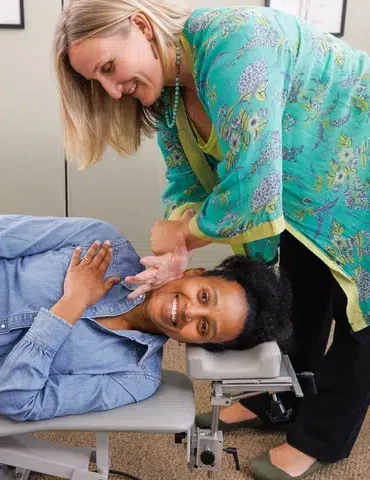
Upper cervical care looks at the alignment of the top of the neck and how your posture organizes itself beneath it. At Equilibrium Spinal Care, Dr. Biek uses the NUCCA method, an imaging-guided approach that maps your individual anatomy before any gentle, low-force correction is made. There is no twisting and no forceful manipulation.
The assessment itself is the useful part here. It measures whether your head is sitting level, whether your hips are even, and whether the two relate. Many people find that upper cervical care fits alongside physical therapy and medical care, added to them rather than replacing any part of them.
If you have corrected the chair, the mattress, the stretches, and the standing desk and your back still hurts, the next useful step is not another correction. It is finding out whether something is loading unevenly in the first place. An upper cervical evaluation with our Oakland chiropractor is straightforward: imaging, an exam, and a clear answer about whether your alignment is contributing. At Equilibrium Spinal Care, Dr. Marie Biek offers a gentle and thorough evaluation of the upper neck.
Schedule a consultation and see whether this is the piece worth examining.

Why does my back hurt for no reason when my scan came back normal?
Because a normal scan rules out specific problems rather than confirming nothing is happening. Most low back pain is non-specific, meaning no single structure can be identified as the source. That is the usual outcome, not a missed diagnosis, and it does not mean the pain is in your head.
Does an abnormal scan mean I have found the cause?
Not necessarily. Disc bulges and degenerative changes appear frequently in people with no pain at all, and they become more common with age. A finding on imaging has to match your symptoms and examination to mean much. Your physician weighs those together rather than reading the scan alone.
Is it a bad sign that I cannot point to an injury?
No. Back pain with no injury is extremely common. The absence of a specific injury tends to mean the load built up gradually rather than arriving in one moment, which is a different story but not a worse one.
Should I rest my back or keep moving?
Current guidance favors staying active within what you tolerate, rather than bed rest, which tends to slow recovery. That said, if your pain is severe or changing, get guidance from your physician on what activity is appropriate for your situation.
Does bad posture cause non-specific low back pain?
The link is weaker than most people assume. There is no single correct posture, and sitting imperfectly does not reliably produce pain. What matters more is sustained asymmetry and lack of variation. That is different from posture in the sit-up-straight sense.
Can something in my neck really affect my lower back?
It can contribute. Your body organizes itself around keeping your head and eyes level, so alignment at the top influences how weight distributes lower down. It is a contributor to loading rather than a cause of non-specific low back pain, and it is worth checking precisely because standard back examinations do not look there.
Does upper cervical care replace physical therapy or my doctor's care?
No. It is designed to work alongside both. Your physician evaluates and manages the back itself, and physical therapy builds capacity and movement. Upper cervical care for low back pain in Oakland looks only at a structural contributor that neither assessment is scoped to measure.
Why does my back pain come and go without a pattern?
Load tolerance varies day to day with sleep, stress, illness, and activity, so the same body can handle more on some days than others. A flare after an ordinary week usually reflects a narrower margin that week rather than new damage.
To schedule a consultation with Dr. Biek, call our Oakland office at 510-694-4903. You can also click the button below.

If you are outside of the local area, you can find an Upper Cervical Doctor near you at www.uppercervicalawareness.com.

















Mon, Wed, Friday 12:00pm - 7:00pm
Tues & Thurs CLOSED
Sat & Sun CLOSED
To schedule a consultation with our office call our number (510) 694-4903 or click the consultation button below.