Who the Blog is For: You have started asking why does my neck hurt when I look down, and you have already done the obvious things. The monitor is higher. The chair is better. You straighten up a dozen times a day. You are in Oakland, or somewhere along the inner East Bay between Berkeley and Alameda, and by mid-afternoon the ache is back anyway.
There is a particular kind of tiredness that comes from doing everything you were told to do and getting nowhere. Everyone says posture, and you have done posture. So when nothing changes, there are only two conclusions left, and neither is comfortable: either you are somehow still getting it wrong, or this is simply your neck now and the rest of your working life looks like this.
Most people quietly settle on the second. They stop bringing it up, build the day around it, and come to accept the ache as the cost of the job. That is the conclusion worth pushing back on, because what is going on here has less to do with how your posture looks than with how long you hold it, and with something underneath that nobody has measured.
Quick Answer: Looking down increases the load your neck muscles have to hold, and the further forward your head goes, the more they carry. Sustained time in one position matters more than whether the position looks correct. A commonly overlooked piece is whether your head sits level to begin with, which changes how evenly that load distributes.
Your head is heavy, and your neck muscles hold it against gravity all day. When you tip forward to read a phone, the weight shifts further from where your spine supports it, and the muscles at the back of your neck work harder to keep your eyes where you want them. That is ordinary mechanics, and why the ache builds during the task rather than at the start.
The evidence connecting posture shape to neck pain is weaker than the advice suggests. People who sit beautifully get neck pain. People who slouch often do not. What holds up better is duration and sameness: long stretches in one fixed position with little variation, which is a different problem than sitting incorrectly.
A standard neck examination is scoped to answer specific questions. Is there a fracture, is a nerve compressed, is there an inflammatory process, how far can you move and where does it catch. It is thorough for what it is built to rule out. What it does not assess is whether your head sits level over your shoulders.
When to Seek Urgent Care: Seek urgent medical care if neck pain comes with weakness, numbness, or new clumsiness in your hands, changes in your walking or balance, or new bladder or bowel changes, which can indicate spinal cord involvement. Sudden severe neck pain with slurred speech, facial drooping, vision changes, or a severe headache unlike any you have had needs emergency assessment. Neck pain after a fall or collision, or alongside fever or unexplained weight loss, warrants prompt medical evaluation rather than waiting.
Your body works to keep your eyes level with the horizon. If the top of your neck holds a misalignment, your head rests slightly off-center and everything beneath it compensates. One side of your neck holds more than the other. A shoulder sits higher. You do not feel yourself doing any of it.
Now add the hours. Every stretch spent looking down loads a frame that was already uneven before you picked up the phone. Both sides work, but not equally, and the side doing more aches first.
This is not the cause of neck pain, and most neck pain has no single identifiable source regardless of alignment. It is a structural contributor to how that load is shared, and one of the few that can be measured rather than estimated.

The standard guidance is reasonable. Raise the screen, take breaks, move often. Moving more genuinely helps, and the break reminders are closer to the mechanism than the sit-up-straight part.
What it assumes is a frame loading evenly. If your head sits slightly off-center, you can hold every recommended position correctly and still load one side harder each time. The effort is not wasted. It is working around something nobody has looked at.
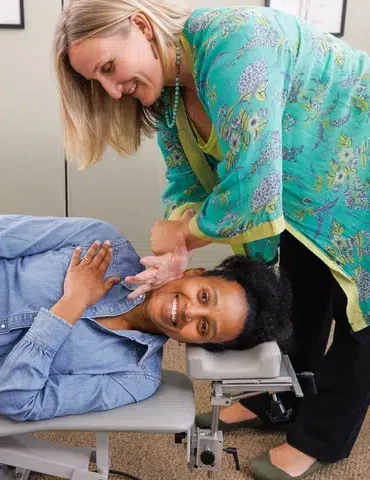
Upper cervical care looks at the alignment of the top of the neck and how the rest of your posture organizes beneath it. At Equilibrium Spinal Care, Dr. Biek uses the NUCCA method, an imaging-guided approach that maps your individual anatomy before any gentle, low-force correction is made. There is no twisting or forceful manipulation.
The measurement is the useful part here. It shows whether your head sits level, whether your shoulders and hips are even, and whether the pattern you feel at day's end matches the imaging. Many people find that upper cervical care fits alongside physical therapy and medical care, added to them rather than replacing any part of them.
If you have raised the monitor, fixed the chair, and corrected yourself all week and your neck still aches, the next useful step is not another correction. It is finding out whether your frame is loading evenly. An upper cervical evaluation is straightforward: imaging, an exam, and a clear answer about whether your alignment is part of this. At Equilibrium Spinal Care in Oakland, Dr. Marie Biek offers a gentle evaluation.
Schedule a consultation and see whether this is the piece worth examining.

Why does my neck hurt when I look down but feel fine the rest of the time?
Because the position is what changes the load, not the neck itself. Tipping your head forward asks the muscles at the back of your neck to hold more weight, so symptoms show during the task and settle when you stop. If one side consistently complains before the other, that asymmetry is worth having looked at.
Is text neck a real diagnosis?
Not a formal one. It is a popular label for neck symptoms associated with sustained phone and screen use. The underlying mechanics are real, but the term implies a specific condition that clinicians do not diagnose, and it tends to put the blame on the device rather than on how long any one position is held.
How often should I actually change position?
There is no magic interval, and the research does not support one. The useful principle is variation rather than a timer: shift how you are sitting, stand for part of a call, look up and away from the screen periodically. Frequent small changes do more than one long correction.
Does a standing desk prevent neck pain?
Not on its own. Standing swaps one sustained position for another, and standing still for hours brings its own strain. What helps is alternating between positions. If your monitor is below eye level while standing, you are still looking down, just on your feet.
Do posture correctors or braces help?
They can give a short-term reminder of where your shoulders are, which some people find useful. Worn for long stretches they let the supporting muscles do less, and the evidence that they resolve neck pain is thin. They are better thought of as a cue than a solution.
Why does my neck hurt more on one side than the other?
Most people have some asymmetry in how they sit, carry bags, and hold a phone, and that alone can favor one side. Persistent one-sided symptoms can also reflect how your head is sitting, since an off-center head means one side holds more all day. Consistent one-sidedness is worth evaluating rather than stretching around.
Can my neck be behind the headache I get at the end of the day?
It can. Headaches that start at the base of the skull and spread forward often involve shared nerve pathways between the upper neck and the head, which is why neck tension and head pain so often occur together. Your physician can help distinguish this from migraine, which is managed differently.
To schedule a consultation with Dr. Biek, call our Oakland office at 510-694-4903. You can also click the button below.

If you are outside of the local area, you can find an Upper Cervical Doctor near you at www.uppercervicalawareness.com.


















Mon, Wed, Friday 12:00pm - 7:00pm
Tues & Thurs CLOSED
Sat & Sun CLOSED
To schedule a consultation with our office call our number (510) 694-4903 or click the consultation button below.